
Size Does Matter
Why Bigger Isn’t Always Better: Scaling Laws and the Muscle Growth Paradox

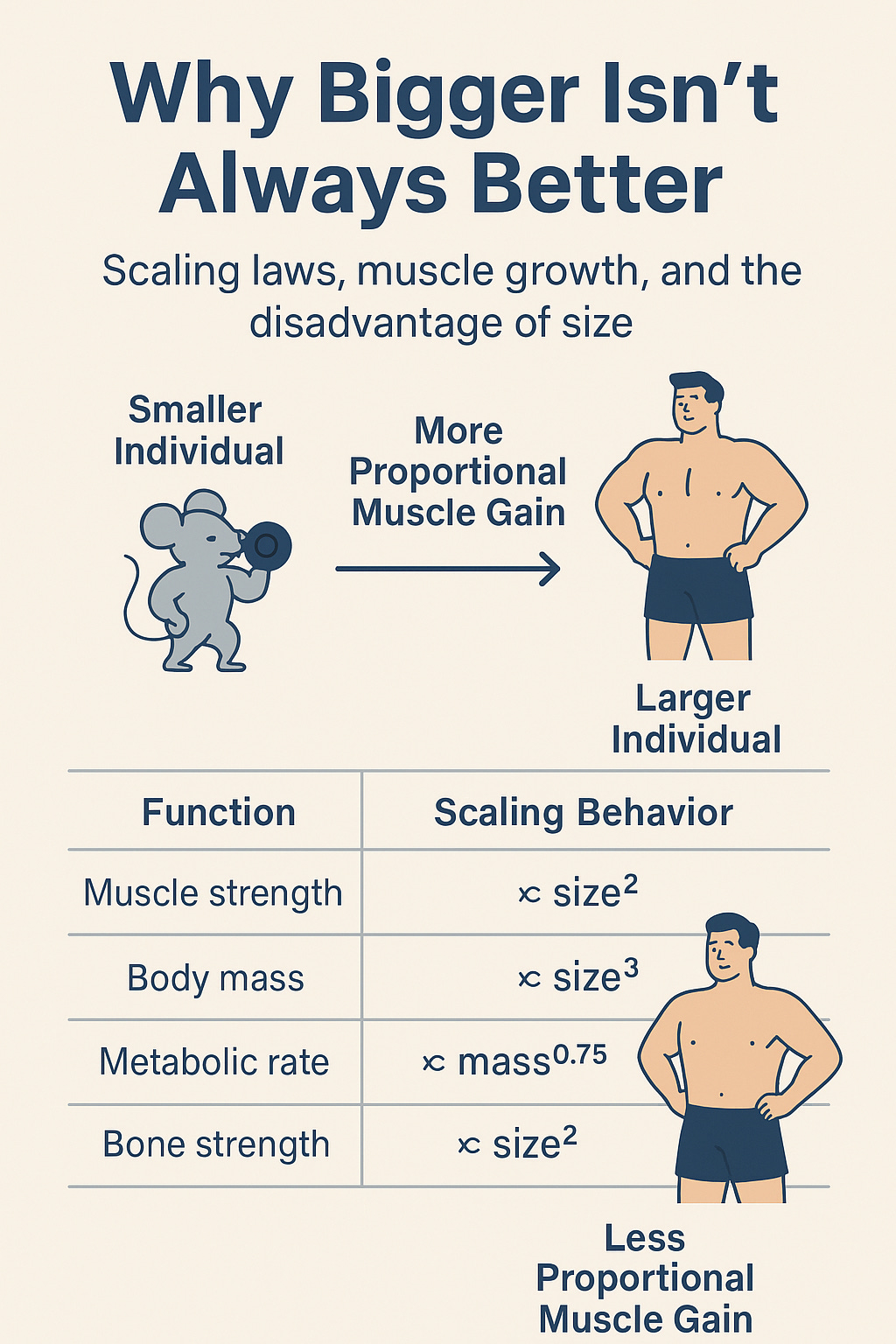
Why Bigger Isn’t Always Better
Scaling Laws and the Muscle Growth Paradox
You’d think the bigger you are, the more muscle you can build.
You’ve got the frame, the mass, the raw material — surely you can scale up like a juggernaut.
But the body doesn’t play fair.
Biology doesn’t scale linearly.
And if you’re already large, you might actually be disadvantaged when it comes to proportional muscle growth.
Welcome to the weird world of allometric scaling — where doubling your size doesn’t mean doubling your power, and elephants can’t jump (literally).
The Muscle Growth Paradox
Let’s say you have two lifters:
Sam is 5’5”, 145 lbs
Max is 6’4”, 220 lbs
They train the same, eat the same, and recover like pros.
After a year of hypertrophy-focused lifting:
Sam gains 25 lbs of muscle (~17% increase)
Max gains 25 lbs of muscle (~11% increase)
Same absolute gain, but Sam’s relative gain is much higher.
Why?
Because Biology Hates Straight Lines
As creatures scale up in size:
Mass increases by the cube (L³)
Muscle force (cross-sectional area) increases by the square (L²)
That means bigger people gain more mass than force.
They pay a biomechanical tax for their size.
And it gets worse.
Other Reasons Bigger ≠ More Gains
1.
Mechanical Disadvantage
Larger bodies have longer levers, which can:
Increase the range of motion
Reduce mechanical advantage at joints
Increase joint stress for the same movement
The barbell may be the same weight — but the tendon load isn’t.
2.
Slower Nutrient Delivery
Bigger muscles = longer capillaries = more time, more blood, more recovery demand.
Each gram of muscle costs more to maintain.
3.
Hormonal Signals Don’t Scale Up
A bigger person doesn’t automatically get more testosterone or IGF-1.
You get what your genes give you — regardless of how much mass you’re trying to support.
4.
Support Tissue Costs
Larger frames require more:
Connective tissue
Bone mass
Blood volume
None of that contributes to force production. It’s just overhead.
Why Mice Have the Edge (and Elephants Don’t)
This paradox isn’t just for lifters.
Nature has been playing this game a long time.
Mice: Heart rate ~600 bpm, live 2 years
Elephants: Heart rate ~30 bpm, live 70 years
But total lifetime heartbeats? Roughly the same.
Scaling laws show up everywhere:
Function
Scaling Behavior
Muscle strength
∝ body size²
Body mass
∝ body size³
Metabolic rate
∝ mass⁰.⁷⁵
Bone strength
∝ cross-section (L²)
Heat loss
∝ surface area
So if you’re small and wondering why your big friend isn’t crushing you in the gym — this is why.
You’re not broken. You’re optimized.
And if you’re big and wondering why you’re working harder for less percentage gain — same answer. You’re just fighting physics.
Implications for Training
Compare you to you. Not the giant next to you or the phenom online.
Don’t chase size for its own sake. The metabolic and recovery costs scale faster than the benefits.
Joint stress matters more as you grow. Protect your levers.
Power-to-weight ratio is underrated. Especially in sports, endurance, and longevity.
Final Thought
Bigger might impress people.
But smarter impresses biology.
So build muscle.
Just don’t expect your size to save you from the math.