
Space Relations: When Fiction Predicts the Unthinkable
A dark literary sci-fi novel from 1973, written by William Barr's father, eerily mirrors Epstein's real-world network. Coincidence—or blueprint?

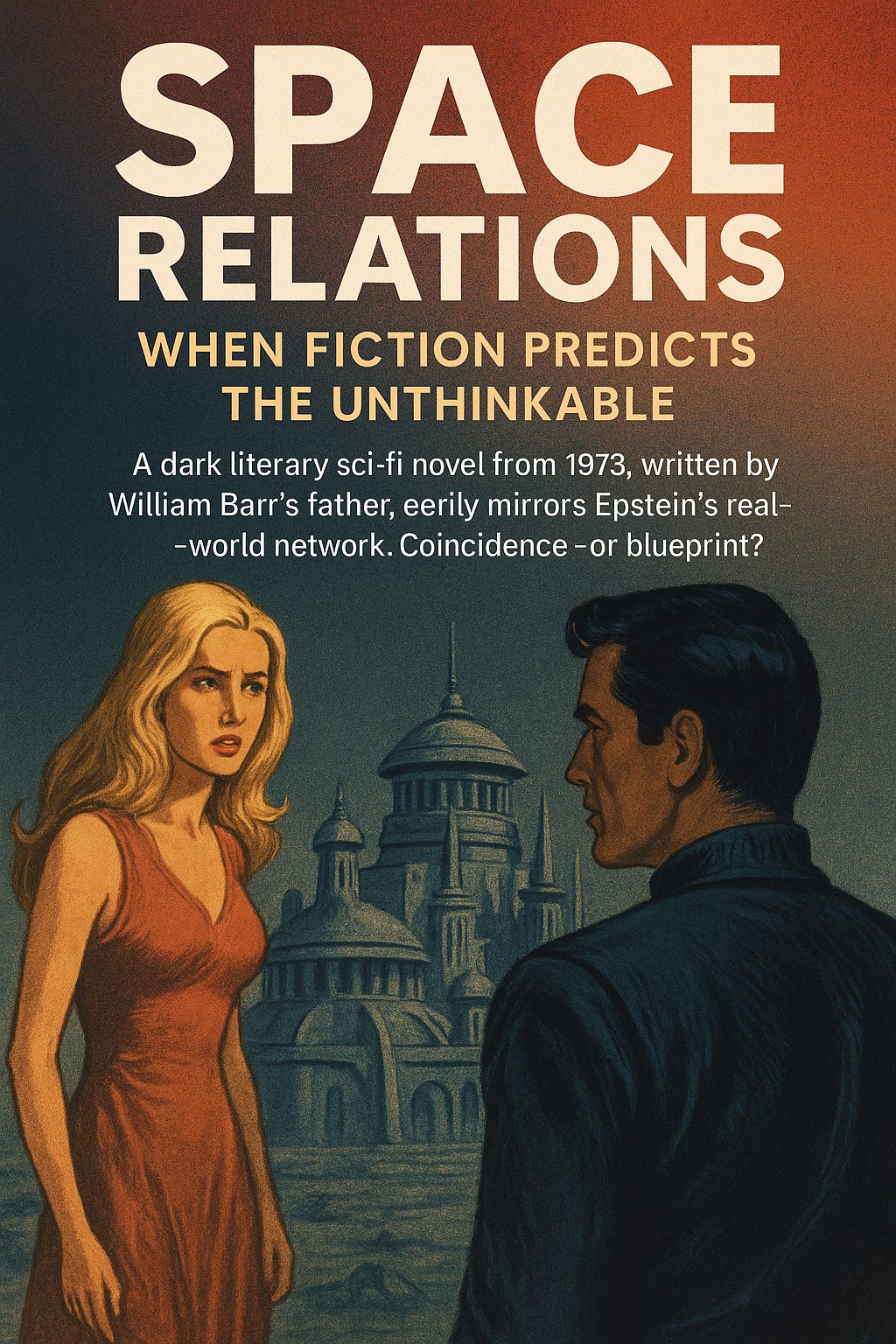
Introduction: Fiction Meets Reality
In 1973, Donald Barr—a former OSS agent, headmaster of an elite private school, and father to future Attorney General William Barr—published a sci-fi novel called Space Relations. The book featured an aristocratic human empire where young women are kidnapped from Earth and sold into sexual slavery on another planet. Sound familiar? It should.
The novel languished in obscurity for decades—until Epstein’s web of trafficking, blackmail, and protection unraveled under public scrutiny. Then, the uncomfortable similarities between Space Relations and Epstein’s real-world behavior began circulating in fringe corners of the internet.
This isn’t an exposé. It’s a literary comparison. But fiction often tells us what the powerful don’t say out loud. The question is: was Donald Barr speculating... or confessing?
1. Barr’s Fictional Universe: A Brief Primer
In Space Relations, a diplomat named John Craig crash-lands on the planet Kossar, ruled by an aristocracy who keep human slaves. The plot involves Craig grappling with the moral rot of the system while gradually integrating into it. Slavery is normalized, particularly sexual slavery. Young women are taken from Earth and brought to Kossar as concubines. The language is clinical, but the implications are grotesque.
The book explores elitism, the banality of evil, and the slippery ethics of those who benefit from power structures, even when they intellectually oppose them. Craig is horrified by what he sees but eventually becomes complicit. That, perhaps, is the most chilling note of all.
2. Epstein’s Surveillance State
Jeffrey Epstein ran a private empire not unlike the fictional Kossar. His was a domain of surveillance, manipulation, and hierarchy. Multiple accusers reported being recruited as minors, groomed, and funneled into networks of high-status abusers.
Like the elites of Space Relations, Epstein operated in a world where wealth excused—or enabled—depravity. Private islands, luxury compounds, and a Rolodex full of world leaders created an ecosystem where accountability couldn't survive.
And like Kossar, Epstein's world was not just about exploitation, but observation. Rooms wired for surveillance. Flights logged. Secrets kept. Or traded.
3. The Bridge Between Fiction and Reality
The parallels between Barr's novel and Epstein's empire go beyond narrative coincidence:
Young women transported and controlled
Elitist societies functioning beyond moral scrutiny
A central character (Craig/Epstein) who both manipulates and reflects the system
Moral ambiguity and complicity as core themes
Donald Barr hired Epstein to teach at the Dalton School—despite Epstein lacking a college degree. He wrote Space Relations just a few years earlier. The web connecting the two men isn’t tight. But it exists. And in speculative fiction, even weak connections can make strong statements.
4. Promotion and Protection: Historical Parallels
Fiction reflects its time. Space Relations emerged in the post-Watergate era, when institutional rot was newly visible. Epstein rose in the neoliberal boom, protected by media silence and legal leniency.
Both stories—real and imagined—suggest an enduring theme: that elites can act without consequence when their actions are buffered by wealth, ambiguity, and institutional indifference.
Is Space Relations a prediction? A projection? Or just one of those unsettling literary flukes that only make sense in hindsight?
Conclusion: Fiction as Blueprint, Reality as Indictment
This isn’t a claim that Space Relations proves anything. But it’s hard to ignore a narrative that mirrors reality so closely, penned by someone so proximate to the real-world players.
Literature often allows taboo truths to surface under the guise of fantasy. That’s why dystopian fiction survives long after revolutions fade. In that sense, Donald Barr’s novel might be less about space—and more about the gravitational pull of power.
Ignore the buttons. They're part of the simulation.
Interesting read Thankyou